Stairlift not working: the maker's checks first, then a repair quote
Stairlift not working, beeping or showing a code? The answer is usually in the maker's own user manual. The code, light or beep says what the lift has detected, and the manual says which simple checks an owner may make and when it needs an engineer. Pick what your lift is doing and you get those checks for your make and model, each with the manual page it comes from.
If the checks do not clear it, the form asks for a repair quote; SEO Dons Ltd reads it and replies by email. If someone is stuck on the stairs and hurt, call 999 first.
Start with the maker's own checks
Pick one of the options to carry on.
Go straight to the fault
Each page starts with what the lift is doing, then gives every make's own answer.
- It will not move, or keeps stoppingSafety edges, the seat position and the switches, as each maker lists them.
- It keeps beepingUsually a lift that is not charging. What each make's beeps mean.
- It shows a code or a lightThe library: pick the make first, because codes differ between makes and models.
- It has stopped with someone on itThe person first: the makers' own advice, and when to dial 999.
- The battery runs down or will not chargeWhere it is parked, the wall switch and a power cut come before the battery.
- The remote, key or switch does nothingHandset batteries, the key and the switches, model by model.
Or start from the make: Stannah, Acorn, Handicare, Brooks, Minivator or the thyssenkrupp Flow range. The manual finder links each model's user manual on the maker's own website.
First checks, model by model: the switches, the key and the charge point
A lot of "not working" turns out to be power that has been switched off somewhere. Stannah's, Acorn's and Handicare's manuals all print where each lift's switches and key are, and warn what happens if one is left off: Acorn's 130 manual says the battery isolation switch must stay on at all times, or the batteries lose their charge (Acorn 130 manualp.10). Stannah's guides say the stairlift will not work with the master power switch off (Stannah 600 guidep.9).
| Model | Power switch | Key | Where it charges | Source |
|---|---|---|---|---|
| Stannah 600 | Master power switch on the back of the base of the chair, normally left on; an on/off switch with a light on the chair | Pushed fully into the keyhole on the side of the chair (Siena, Starla); on Sofia and Solus chairs it goes in the end of the control pod and turns to on | A battery charger at the top or bottom of the stairs; Stannah's beeping page says a straight lift charges wherever it stops on the rail | 600 guidespp.7-10 |
| Stannah 260 | Master power switch on the front of the chair, normally left on | Keyhole on the front of the chair; key in and turned to on, then the on/off switch to on | Charge points usually at the top or bottom of the rail; Stannah asks for the chair to be right at the top or bottom | 260 guidepp.7-10 |
| Stannah 420 | Master power switch on the rear of the chair, normally left on | Keyhole on the side of the chair; key fully in | A battery charger at the top or bottom of the stairs, with the wall switch left on | 420 guidepp.7-9 |
| Acorn 130 | Battery isolation switch on the wall side edge or rear of the carriage cover: always on | Key switch on the carriage cover, turned clockwise; key out or turned left shows E9 | Top or bottom of a standard rail, where it stops by itself and beeps once on arrival | 130 manualpp.10-18 |
| Acorn 180 | A switch pushed until its green light shows | Inserted and turned clockwise | Charging points at the top and bottom, or an intermediate point if a hinge is fitted | 180 manualpp.8-11 |
Handicare, Brooks, Minivator and thyssenkrupp lifts: see each make's page, which says what that maker publishes for owners and where it publishes nothing.
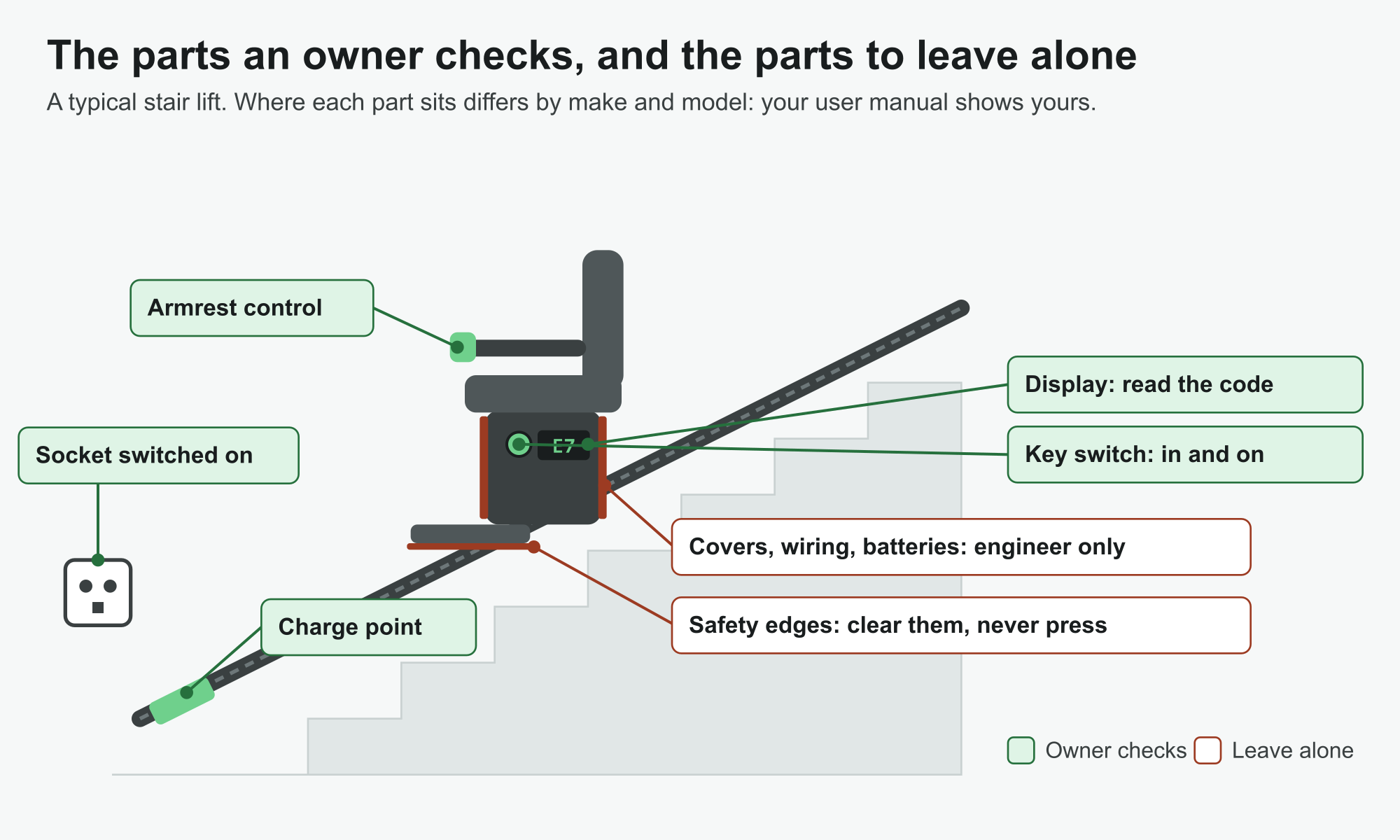
A code means one thing on one model
The same letters and numbers turn up on different lifts with different meanings, so a code on its own tells you very little. Acorn is the clearest case. On the 130 the display counts up from C1 to C5 while the batteries charge and shows C6 when they are full (Acorn 130 manualp.24). On the curved 180, C4 already means fully charged (Acorn 180 manualp.16). Stannah's 600 uses plain numbers instead, from 1 to 9 and F, and its 260 and 420 guides give no codes at all, only a checklist of symptoms.
That is why the stair lift error code library asks for the make first and keeps every model's rows apart. Each row gives the maker's meaning in plain words, the check the maker allows an owner, and the point where the maker says to call an engineer. Where a code people search for is not in the maker's manual at all, the library says so rather than guess: Stannah's 600 guides, for example, have no code 8.
If it beeps
A stair lift that beeps while it is parked is usually telling you it is not charging. Stannah's 260 guide puts it plainly: the batteries are not being charged, though the lift can carry on running on them for now. Its checks are the wall switch, a power cut, and whether the chair is right at the top or bottom of the stairs (Stannah 260 guidep.25).
Acorn lifts that are not on a charge point, or have lost power, beep for about a minute and then go to sleep. After that the 130 gives a double beep roughly every 40 seconds, and the 180 beeps every 20 seconds with its display dark. Using the controls wakes either one, and the manuals then say to park it on a charge point (Acorn 130 manualp.22, Acorn 180 manualp.20). The full list, including Acorn's flat-battery alarm, is on the stair lift beeping page, and the charging side is on battery problems.
If it stops with someone on it
The person comes before the lift
If someone is hurt, or cannot get off safely, call 999. The NHS says 999 is for life-threatening emergencies.
Stannah's own advice when a lift stops on the stairs is to stay seated and see if you can restart it or summon help; if you have to get off, make sure you can do it safely, take it slowly and ideally have someone help (Stannah troubleshooting tipsweb page). Both makers suggest carrying a mobile phone or another way to alert people when you use the lift alone. The restart each maker gives, and what never to try, are on the stuck on the stairs page.
Common worries before you try anything
Will switching it off and on do harm?
Not when it is the maker's own reset. Acorn's 130 manual gives one: battery isolation switch off, wait 30 seconds, back on, which clears the codes on the display (Acorn 130 manualp.22). Stannah's guides restart with the power key. What does harm is leaving a lift switched off: Stannah warns that it drains the batteries, so they need replacing sooner.
Can I change the batteries myself?
Every maker read says no. Stannah's battery page tells owners never to try it themselves and to leave it to a trained engineer, and Acorn's manuals say batteries that have run too low have to be replaced by an engineer, as a chargeable job (Stannah batteries pageweb page). Battery replacement has what each maker says.
What if my code is not in the manual?
Then nobody outside the maker can tell you for certain what it means, whatever a forum says. This guide publishes no meaning for it: give the code and the model to an engineer, or to the maker.
What this guide will never tell you to do
The makers give owners a short list of things to check. Everything else on a stair lift is an engineer's job, and some of it is written in the manuals only so an engineer can find it. This guide sticks to the owner's list.
Owner checks the manuals give
- Switches and the key: on, and in properly
- The wall socket or spur switched on, and no power cut
- The chair parked where it charges
- The seat turned back and locked, the arms lowered, the belt fastened where the lift needs it
- Something in the way: back the lift off and clear it
- A reset, where the maker gives owners one
Never, whatever a video shows
- Opening a cover or touching wiring or fuses
- Pressing, taping or adjusting a safety edge or sensor
- Hand winding the lift, or using override or emergency-drive controls
- Changing the lift's own batteries
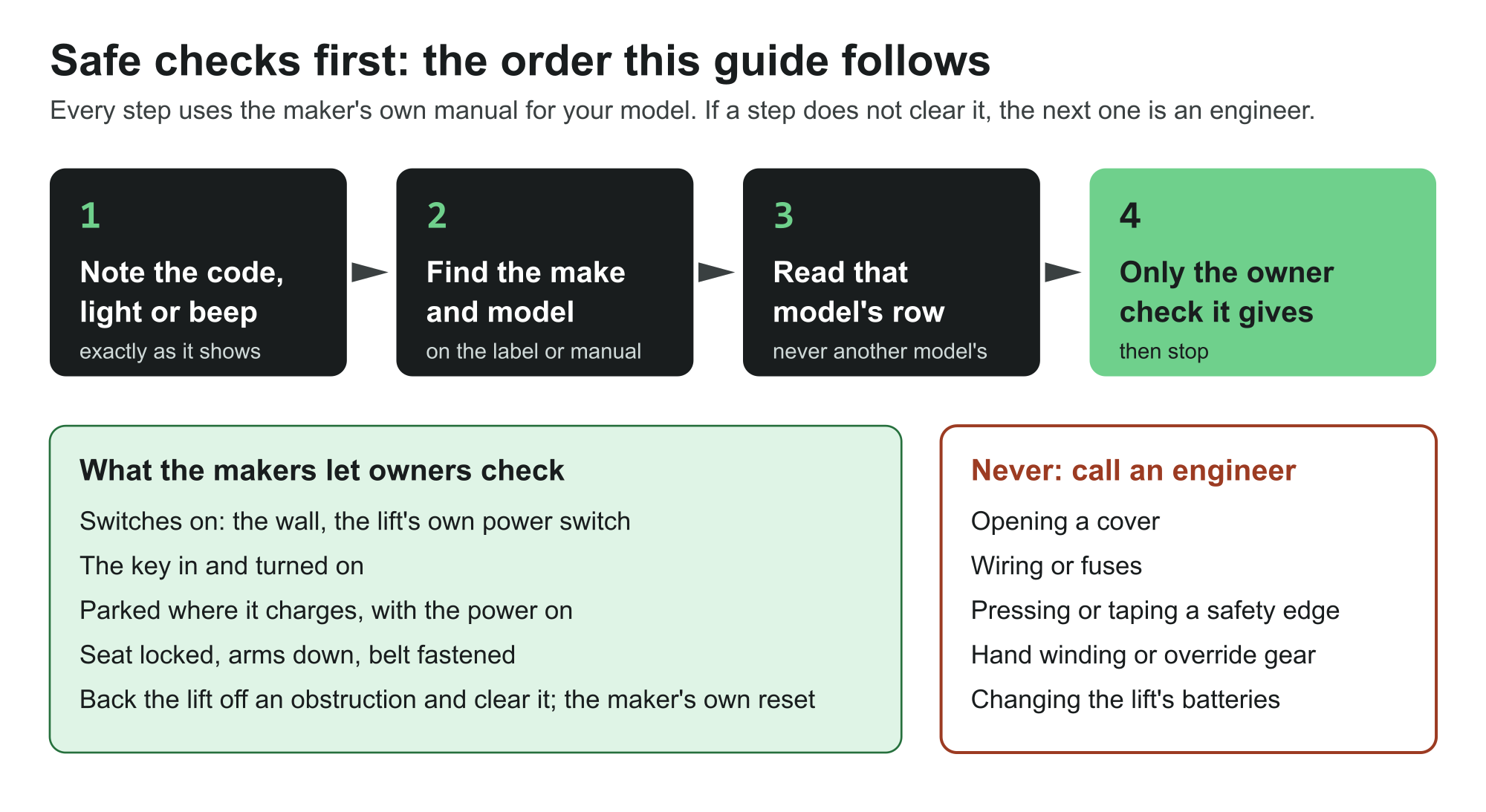
Where a manual does describe one of these, the code pages cite the page and say to call an engineer. Acorn's 130 manual, for example, answers its F6 and F7 codes with hand winding; here those rows say to leave it to an engineer. More on the rule, and on how every row is sourced, is on the about page.
When the manual says call an engineer
Most code tables end the same way: if the owner check does not clear it, contact the supplier, the branch or the authorised dealer. If the lift is under a warranty or a service plan, or a council or housing association provided it, that is the first call. Otherwise, the repair quote form on this page sends the make, the model and what the lift is doing to SEO Dons Ltd, which replies by email. This guide does not price repairs or rate engineers: it stops where the manual says to call one.
Have the model and the exact code or beep ready when you ask. The manual finder shows where each maker prints the model, and the reset page lists what to try before you ring.
Owners ask
On Stannah's 260 and 420, a lit power light means power is reaching the chair, so the guides send you to the seat position, the safety edges and, where fitted, the hinged rail. On a Stannah 600 or an Acorn, read the display first: it names what the lift has detected. The code library has each one with its manual page.
Only in the way the maker's manual gives it to owners. Acorn's 130 manual gives a reset with the battery isolation switch; Stannah's guides use the power key. Neither involves opening the lift. How each maker's reset works.
Stannah's 260 guide says a beeping lift can carry on running on its batteries for now, but the beep means they are not charging, so they will run down. Find out why first: beeping, make by make.
The manual names who: Stannah's guides say your Stannah supplier or local branch, Acorn's say your authorised Acorn dealer. If you would like a quote for the repair, the form on this page reaches SEO Dons Ltd, which replies by email.
Where this comes from
Each meaning, check and number above is taken from the documents listed here, opened on the maker's own website. Page numbers in the text are the numbers printed in each manual. How the makers' documents are checked.
- Stannah: Model 600 Siena: Looking after your stairlift
- Stannah: Model 260 Siena: Looking after your stairlift
- Stannah: Model 420 Starla: Looking after your stairlift
- Stannah: Stairlift troubleshooting tips
- Stannah: All you need to know about stairlift batteries
- Acorn Stairlifts: Acorn Superglide 130 straight stairlift user manual (control board T700)
- Acorn Stairlifts: Acorn 180 curved stairlift user manual (T565)
- NHS: When to call 999
Get a stair lift repair quote
For when the maker's manual says it is a job for an engineer. Give the make, the model and what the lift shows or does. Replies come by email, so this is not the way to get help for someone stuck on a lift now.
After you press send
- SEO Dons Ltd, which publishes Stairlift Support, receives what you send.
- Someone reads the make, the model and the fault, and replies by email.
- There is no obligation: asking does not commit you to any repair.